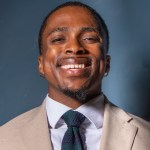
Seated in a meeting room at the Montford Convention, his back sinks into the chair like an emperor settling onto his throne. No cane or no walker in sight for walking assistance, the man’s calm expression says more than words ever could. Before he even has a chance to introduce himself, the sergeant speaks for him. The weight of history seems to hover around him, a presence that makes a formal introduction almost unnecessary.
“Meet General Britton,” the sergeant says, and Britton’s smile matches the warmth of the greeting. Theodore Britton Jr., 99, is what some might call a pioneer, a harbinger, a vanguard, a man who has shaken hands with presidents and politicians, and acknowledged by Queen Elizabeth. Yet despite all that, Britton carries himself with humility. He downplays accomplishments that others would broadcast, though his intelligence is impossible to hide. Over lunch, he might casually order a tuna sandwich while giving an intellectual breakdown of a polymath, or mention a book you’ve never heard of but immediately want to Google.
Some might claim to be the first. But Britton—he truly was one of the first. Before Jackie Robinson broke the color barrier, before Black and white Americans could sit together on the same bus, Britton had already etched his name into history as one of the first Black United States Marines. For him and thousands of other Black Marines in the 1940s, Montford Point was where their Marine story began—a chapter that, decades later, would earn him the nation’s Congressional Gold Medal in recognition of that service.
As he nears his centennial, his story of Montford Point is only a fraction of the accomplishments and lives he has touched in more than 36,000 days of living.

Life in Blue Heaven
The middle child of parents, Bessie Britton, and property manager, Theodore R. Britton Sr., Britton spent his earliest years in a small community just outside North Augusta, South Carolina. “We called it Blue Heaven because it was composed of something like eight or ten houses, and they were all painted blue,” said Mr. Britton.
For a young boy growing up in the segregated South, separation from white neighbors never felt like a burden. “The fact that I was living in a separate area didn’t bother me. I never assumed it meant anything was wrong or that I was inferior,” he said. Blue Heaven shaped his childhood—from walking to the corner store with his sisters for peanut butter or fresh sugar water, to discovering the joy of learning in the classroom. It was there he met a teacher named Ms. Lina Key, despite juggling four different grade levels, made a lasting impression with her dedication and care.
Teachers gravitated toward him, drawn to his curiosity and erudition. Even as a child, his head was rarely out of a book. “‘I’ve read over a thousand books,’” he said, glancing at the shelves surrounding his Atlanta apartment today.
At ten, his father moved the family to New York City, as he found a job building the subway systems. They first settled in Harlem, but after his father lost his job during the Great Depression, they relocated to downtown Manhattan. The move opened young Britton’s eyes to a new world. The North was no utopia, but its racial lines were often more complex than those of the South.
He recalls seeing a white man in a restaurant collecting scraps of food, a sight that challenged the racial assumptions he’d grown up with. “It made me think that maybe equality or inequality has more to do with circumstances than just race,” he reflected. School introduced him to new experiences, including choir, which led to the glee club, and an early understanding of stocks, which would prove useful later in life. He attended the New York School of Commerce, one of the country’s first trade-focused high schools, planning a future in bookkeeping.

Pioneer Spirit to Pioneer
By 18, the world demanded adult responsibilities of him. In January 1944, Britton, his parents’ only son, was drafted into the military during World War II. Britton reflects that his parents didn’t think much of it at the time.
Like many Black draftees, he was initially offered only the Navy or the Army, options he declined. “I just rejected the fact that I was only given two choices. Maybe it was part of my heritage. My father left South Carolina to go north into the unknown for his family. Maybe that pioneer spirit runs in me,” he said.
Unbeknownst to him, Britton was about to make a choice that would etch his name into history. In 1941, after President Franklin Delano Roosevelt created the Fair Employment Practices Commission, Black men were allowed to enlist in the United States Marine Corps. But like most progress of that era, it came with its conditions. They couldn’t train at Parris Island with their white counterparts. Instead, they were sent to a place carved out just for them, a new camp in North Carolina called Montford Point. From 1942 to 1949, every man who passed through those gates carried more than a rifle; he carried the weight of being among the first. They were the Montford Point Marines—the first Black Marines to wear and embrace the uniform, their footsteps marking the start of something larger than themselves.

Arriving at Montford Point in January 1944, Britton, standing 5’8”, brought a keen intellect that served him well. While Marine boot camp today lasts 13 weeks, he spent five months in training. Some of the first graduates returned as instructors, and Britton recalls, “The Black trainers were convinced we should be better, and they trained us harder.” Montford Point was meant as an experiment. “They expected us to fail. If we failed, the Marines could remain all white. Knowing that pushed us to work even harder.” The Marines who trained there didn’t just meet expectations—they surpassed new standards that reshaped the Corps to this day.
After graduation, Britton boarded a ship in Norfolk, Virginia, on a 33-day voyage into the Pacific. The first place he docked was Guadalcanal, a place he later reflected on as one that broadened his horizons. Britton worked as a clerk, keeping count of the enlisted soldiers overseas. By April 1945, just months before the bombing of Hiroshima, he and other Marines were sent to Hawaii.

However, despite the respect and emerging recognition the Montford Point Marines receive today, the regard they earned from their white counterparts back home was nearly nonexistent during the time. “The ones overseas learned to appreciate us, but the ones back home didn’t even know we existed because they had never heard of Montford Point,” Britton said. Many Marines overseas became aware of the accomplishments of Montford Point graduates—sometimes called “Black Angels,” as some described them- as they would serve as backup countless times in WWII and during the Korean War. Despite their omission from many history books, Montford Point graduates stood in the same trenches as the white Marines remembered in history. Some 2,000 Black Marines took part in the bloodiest battles of World War II, including Okinawa.
In the spring of 1946, Britton returned to the United States with his mind, unsurprisingly, set on educational advancement. After completing his remaining high school credits, he enrolled at one of the country’s highest-ranking schools, on 4th Street in New York City: New York University. He chose to major in banking and finance, which might surprise those aware of his immense vocabulary. Why not English? “I wanted to do something that would be related to diplomacy,” he said. “I first thought about accounting, then I got interested in international trade and foreign exchange, and that’s what drew me to study finance.”

One year into his studies at NYU, in 1948, he was called to active duty as tensions rose in Korea. During this time, he continued with part of his coursework at NYU. He left the Marines in 1951, a year into the Korean War, after being denied a commission due to his prior opposition to the Marine Corps’ segregation policy—a policy rarely mentioned in history. While Montford Point allowed Black recruits to serve, access to military jobs and resources remained far from equal compared with their white counterparts.
Around 1948–49, the Marine Corps proposed an all-Black volunteer trucking unit in Harlem. Britton opposed it, arguing that Black recruits deserved access to regular units, not segregation. Although his strong sentiment would later be used against him, it may have sparked a significant change in the racial construct of the Marines. With support from Congressman Adam Clayton Powell Jr., the objection reached the Secretary of Defense, prompting Major General O.P. Smith to declare that all Marine units would be open regardless of race. The decision marked a small but significant step toward integration.

Made His Parents Proud
After leaving the Marines, Britton obtained his degree from NYU, becoming the first in his family—siblings and parents included—to achieve higher education. “There were no two people more proud of that graduate than my parents,” he recalled. “On the day when 12,000 students graduated from NYU, their son was among them.”
Despite the rigor of NYU, Britton never felt the challenge was insurmountable. “Keep in mind that I had gone through so many difficult experiences before, so I only felt that I could do well, if not better,” he said.
After graduating, he worked as a mortgage officer at the Covington Savings and Loan Association in Harlem. Later, his reach expanded into housing development when he served as Deputy Assistant Secretary at HUD.
In 1974, President Gerald R. Ford nominated Theodore Britton Jr. to serve as U.S. Ambassador to Barbados and Grenada. The position gave him the chance to further broaden the list of countries he had visited. “I’ve probably been close to 170 countries at this point,” he said.
Nearing 36,525 Days
Now closing in on 100 years old, Britton shows no signs of slowing down.
“Nearing 100, and I am on the go,” Britton texted me from his Forida beach house. Time and again, people ask him the same question: “What’s the secret?” And his answer, surprisingly simple, reflects the wisdom of a man whose knowledge could fill several dissertations.
“There can’t be a secret because each person is unique, so what helps me might not help someone else,” Britton said.

As for turning 100 being a milestone—not for him. “I’ve had a lot of birthdays, so it doesn’t mean much.”
When asked what piece of wisdom everyone should carry with them, he offered this: “It is a small, small planet that we live on, and we can be of help to each other.”